
ERP System

A Modular ERP Platform Built to Connect Operations, Sales, Marketing, Inventory, and Customer Management
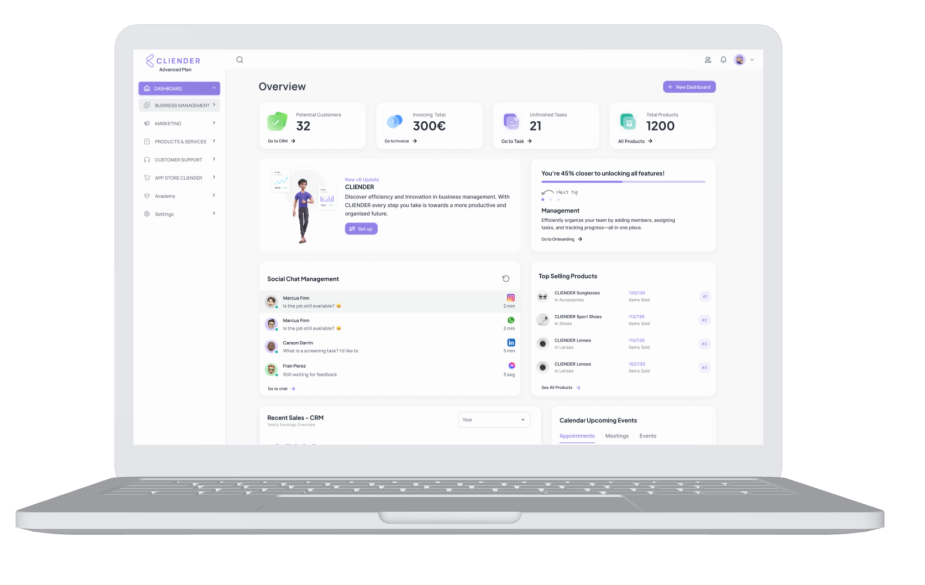

Cliender ERP System

Industry

Multi Industry

System Type

Modular Enterprise ERP

Scope

Architecture, Design, Development, Testing

Model

Subscription Based SaaS

The Context

Modern businesses rarely struggle because they lack ambition.

They struggle because the systems they depend on are fragmented.

Sales teams work in one platform. Marketing data lives somewhere else. Inventory is tracked separately. Customer interactions are scattered across emails, spreadsheets, and disconnected tools.

As organizations grow, these disconnected systems create operational blind spots. Teams spend more time transferring information between platforms than acting on it. The challenge was not simply to build another ERP.

The challenge was to create a connected business ecosystem where every department could operate from a single source of truth.

The Brief

The objective was clear

Build a modular ERP platform that centralizes business operations while remaining flexible enough to adapt to different industries and business sizes.

The system needed to support:

  • Sales and invoicing
  • Customer management
  • Inventory and product operations
  • Marketing activities
  • Team collaboration
  • Business reporting
  • Subscription-based growth

At the same time, it needed to avoid the complexity that often makes traditional ERP systems difficult to adopt.

The goal was to make enterprise software feel as intuitive as modern SaaS products.

Our Approach

Rather than creating a monolithic ERP system, we designed CLIENDER as a modular ecosystem.

Each business function operates as an independent module while sharing a unified data layer.

This architecture allowed organizations to:

  • Start with only the modules they need
  • Scale functionality as they grow
  • Keep all business data connected
  • Eliminate duplicate data entry
  • Maintain a consistent user experience across departments

Every design decision was guided by a simple principle.

Business software should help teams move faster, not create additional operational overhead.

How the Solution Solves the Challenge

Below is how each module directly addresses business pain points

The Challenge

Leaders lacked real time visibility. Decisions were reactive.

Our Solution

Role based dashboards provide instant insight into performance.

Key Capabilities

  • Business health overview
  • Sales and revenue tracking
  • Inventory levels
  • Customer Management
  • E-commerce activity

Business Impact

Faster decisions backed by live data.
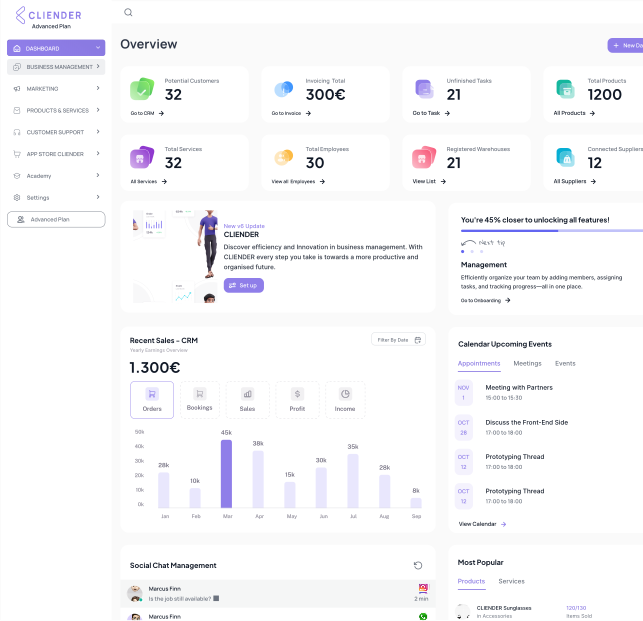
Cliender Enterprise Dashboard

Evolution of the Product

CLIENDER was developed as a scalable SaaS platform designed for continuous expansion.

The modular architecture allows new capabilities to be introduced without disrupting existing operations.

As customer requirements evolve, businesses can activate additional modules while maintaining a consistent experience and shared data structure.

This approach ensures the platform grows alongside the organizations that use it.

The Outcome

CLIENDER became more than an ERP system.
It became a centralized business command center.

Organizations using the platform gained

  • Unified operational visibility
  • Better collaboration between departments
  • Reduced manual processes
  • Improved reporting accuracy
  • Stronger alignment between sales, inventory, marketing, and customer operations

Instead of managing disconnected systems, teams could focus on running and growing their business.

The Vision Realized

Instead of managing disconnected systems, teams could focus on running and growing their business.

It was about creating a platform where operations, sales, marketing, inventory, and customer management work together as a single ecosystem.